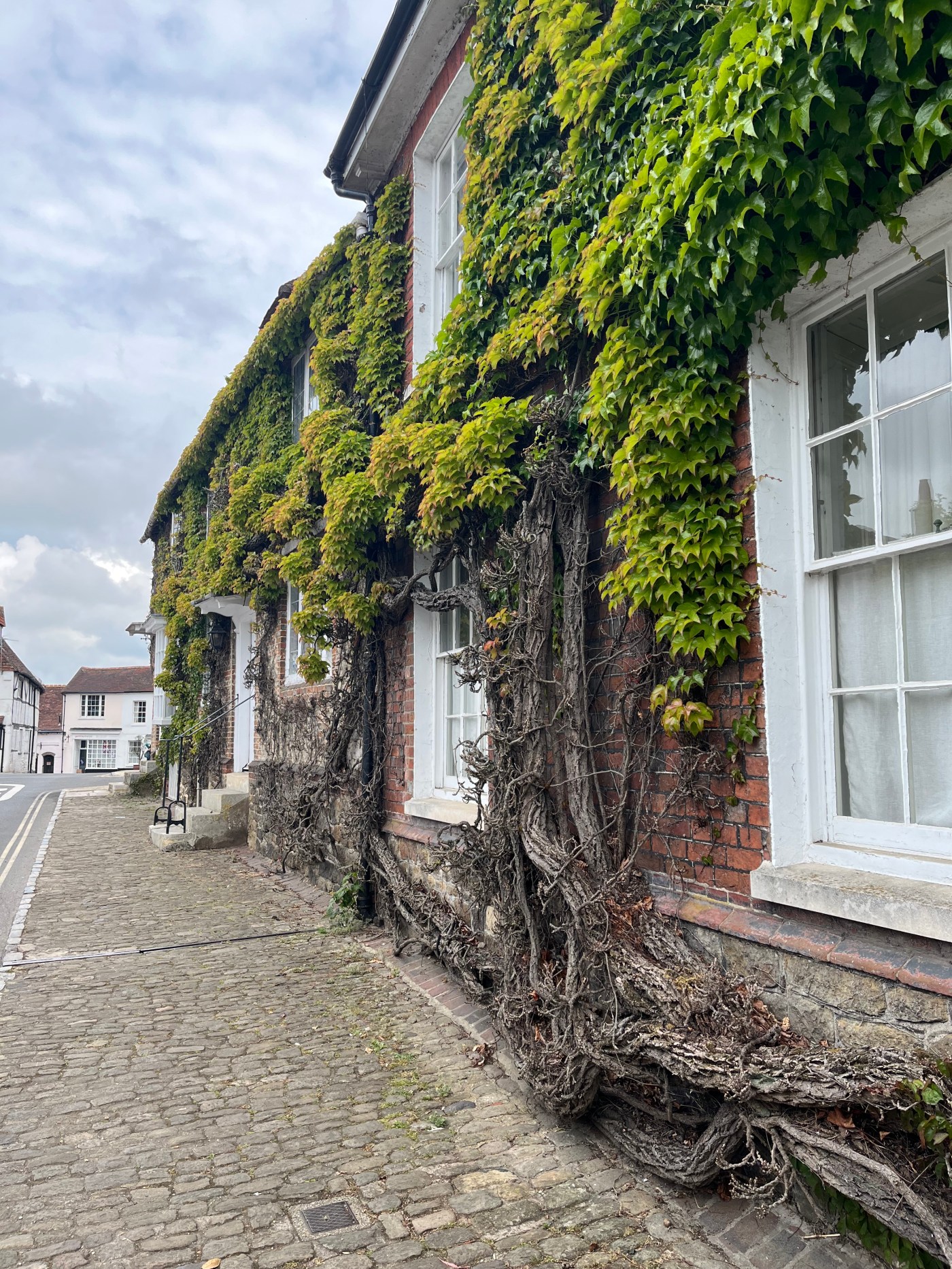
To balance my nutty neighbour tales, let me tell you why we love it here.
Standing in our garden, you can see the church spire just three houses down the road. The church is old – Middle Ages old – although significantly restored, and every Sunday morning at 10am, we get to enjoy the Church bells ringing out for morning service. Not because we participate in church services, but because the peeling of bells is such a joyous sound. Indeed, it’s a twice a week treat, as they practice every Thursday evening. We also get occasional bonus peals for a wedding and other special events – most recently, the bells rang on May 8th to mark VE (Victory in Europe) Day.
This small joy is one of those which make this a happy home. Here’s a few more…
- Located in an area known as the Old Town, we’re surrounded by predominantly Georgian properties, as well as some dating back to Tudor times – so everywhere we walk is not only a beautiful sight, but a site of architectural beauty.
- The Old Town is built around the market square, which the centre of trade in the Middle Ages. In a corner of the square, I came across the old stocks, tucked away behind railings and with only a discreet sign marking their site.
- Every day we walk or drive along a street called Knockhundred Row – the name originates from a time when the Lord of the Mayor could “knock up” 100 men to fight for him.
- Next door to the church is a row of cottages, the frontages of which are covered in such mature creepers they appear more akin to tree trunks (see header image).
- Two old banks have recently been converted into residential dwellings – with one retaining the old vault for posterity. I’m trying not to be one of those neighbours, but there’s no denying that I’d love an invite to have a good gawp 😉
- The house across the road from us has a front door with the distinction of being voted the most beautiful Georgian front door in the county – so the owners proudly informed me 🙂 Yet another property I’d be happy for an invite to view!
- Once a week, a man turns up with a ride-on mower to cut the grass – something which turns the garden into a chore-free pleasure for us to enjoy.
- Two roses climb the walls outside our bedroom windows – one a deep red old garden rose, the second a white rambler. Both beautiful, both requiring no input from us for their care.
- Our landlords – a major landowning Estate – have their roots in the ruined castle on the hilltop immediately to our rear, which was built following the Norman (French) invasion in 1066. Centuries later they built a magnificent manor house on the other side of the river that they named the old French word for hazelwood. The anglicised version of that name is now the name of both the Estate and the title subsequently conferred on its owner.
- Guy Fawkes – of Gunpowder Plot fame – was a footman at the old manor house, and inadvertently caused his employer to spend a year in prison by warning him to stay away from Parliament on the day in question.
- They play polo here – serious, world class polo – on land beside the ruins of the old manor house. We can hear the commentary from our living room, and have priority access to tickets should we fancy attending. When Himself’s eye is better, we’ll take up the opportunity and give our cameras a run out.
Discovering that we’re – quite literally – smack in the middle of centuries of English domestic history has had an impact on me. Not just the Georgian period with its Jane Austen connotations, but how the market square was originally a Medieval trading centre, later becoming a centre for law and commerce, and finally a cattle market in the late 19th century, and that’s before I came across the connection to 1066, that pivotal period in English history. For a person as rootless as myself, being surrounded by all this history has given me a most unexpected sense of grounding.
How do you feel about local history? Does knowing the story of your local area make you feel more connected, or it just mildly interesting?
© Debs Carey, 2025


Are we allowed to guess where you live Debs?
LikeLiked by 1 person
I’m sure you’ll be absolutely on the money Sarah 🙂 I didn’t include the name as it’ll not mean anything to readers in the US.
LikeLike
Midhurst?
LikeLiked by 1 person
Yup – spot on 🙂
LikeLike
Knockhundred Row! The Norman Invasion, Guy Fawkes, polo! You really do live in the middle of a town with history all around you. Plus your architectural beauty is like photos in a coffee table book. I can understand how living where you do now has changed you, I hope for the better.
I’m mildly interested in where I live now, but I grew up in a small town with a history to it that we were taught about in school.
LikeLiked by 1 person
Ally, every time I see the street sign, it makes me smile 🙂 ‘cos I love the idea of the Lord of the Manor “knocking up” people to force them into his army. There’s something about the term which makes me giggle! While there are ordinary, everyday bits of the town, there is much which is pleasing – and is a wonderful contrast to most of where I’ve lived in the UK which has been extremely modern, and not in a good way.
I love the sound of your small town with history 🙂 Is it something you’d consider writing about in your blog? Or maybe you did some time back before I found you?
LikeLiked by 1 person
I don’t know if I’d ever write about it on the blog. I rarely go into my past there. I’ll think about it though. Thanks for the idea.
LikeLiked by 1 person
I’d not want re-visiting it to make you feel uncomfortable Ally. But if you ever felt like it, I don’t doubt it would make for wonderful reading.
LikeLiked by 1 person
Well therein is the catch. My childhood memories are complicated and suited more for some place serious rather than my light-hearted blog.
LikeLiked by 1 person
You are living my dream Debs! Seriously, to be immersed within so much amazing history … I am truly envious. My small town has a level of history to it which I found interesting to research when I moved here, but nothing that goes back as far as yours. In general we don’t get that level of historical emersion anywhere in the US of course, although I do have some indigenous roots from my mom’s family and those are very different from the majority of my European ancestral heritage.
LikeLiked by 1 person
OMG, your village? town? sounds unbelievably picturesque. I’ll have to ask for the name if we ever make it back to the UK. How marvelous. Do you mind me asking where you are relative to London?
LikeLiked by 1 person
I get that Ally. When you’ve made a space for yourself which fulfils your needs and runs to your rules, why would you risk any form of emotional upheaval.
LikeLiked by 1 person
Deb, that’s what’s been so amazing for me. As I was born & brought up in the third world, my childhood history is very different. Since moving to the UK, we’ve lived in the ‘burbs, so new and lacking in history.
That said, your indigenous roots must provide some remarkable history. I hesitate to ask if you’d write about it in case there’s negative emotional connections – but it would be fascinating to learn more if you were comfortable to share.
LikeLiked by 1 person
Autumn, it’s categorised as a (market) town and it is indeed most picturesque, in parts, if not all of it. It’s called Midhurst, but do feel free to ask if you’re heading this way again. It’s about a 2 hours drive into the centre of London. While there’s no railway station in the town, the nearest railway station is about 20 minutes drive from here, and it’s about an hour from there by train into central London.
LikeLiked by 1 person
Oh, Deb, this sounds magical. Do you ever plan on sharing pictures of your town? I know some bloggers prefer to stay a bit anonymous, which I totally understand. But I’ve never been to England (I hope to someday!), and I’d love to see it through your eyes.
LikeLiked by 1 person
I love local history! Adds so much depth!!
LikeLiked by 1 person
What a fabulous post, Debs. I love it! Reading, I feel like I’m in a setting for Midsomer Murders! I spend 4 terms over 4 years doing graduate work in York, doing lots of walking when not studying, and your post reminds me of those memorable days as well. Obviously, very little on this side of the pond has that depth of history, but we live in a part of North America that goes back farther relatively speaking and I feel it all the time. For me, I feel a strong and meaningful connection.
LikeLiked by 1 person
Sadly I have very little personal history about the indigenous roots. In fact honestly I was never fully sure my mom was telling the truth when she randomly brought up that we have “Indian blood” (her words etched in my brain from the 60’s) given her mental health issues and alchoholism. My youngest did a family tree history in her teens and found that yes mom’s father’s side were direct descendents of the upper plains Winnabego tribe. There’s a story to that name and like most of this much of the info can be found online. The tribe actually prefers the name Ho-Chunk. My only other real confirmed piece of info is that a Great x 3 or 4 grandmother named Glory of the Morning was a respected chief of the tribe and apparenly a female chief was not typical. I am directly descended from her line. I never new my grandfather to get any other info, my grandma never spoke of him and there are many secrets and mysteries about the family that none of us can really answer. Mom was the last in the line to officially be recognized by the tribe. My half sister and myself do not have the sanctioned level of DNA (bloodline) to be recognized as a member but…I still feel very proud of this heritage.
LikeLiked by 1 person
The header image is beautiful. It immediately brings to mind all the British dramas I’ve watched. It also reminds me of how much more enjoyable a trip is when you have some background from reading. A small example: While in Canterbury, our hostess drew a map for us of an English country walk. One item on the map was a stile. I guess there are stiles everywhere, but I’d only heard the word in nursery rhymes, which gave our walk a sort of romantic significance.
The US west coast is very young unless you include the indigenous people. Yet there’s still a lot of fascinating history. My city was founded in 1890. The extant old buildings are simple, but the stories of the adventurous people who made it their home are fascinating.
I always like to know something about the history of a place and also about their main industries. What kind of town is this and how did it get this way?
LikeLiked by 1 person
Kari, I hadn’t planned to do so, but as it is so picturesque, there’s no doubt I’ll be taking more & more shots, so I’ll set up a gallery on the blog in due course. I’m unlikely to share the frontage as I wouldn’t want random (non-commenters) being able to recognise where I live, but I do plan to start taking more pics around the town. As you’ll have seen, I do share the odd snap on my Instagram of the garden at the rear of the house.
LikeLiked by 1 person
Deb wow, wow & wow! What you do know is both amazing and sad. Amazing that you have roots (however small) in a proud race and part of the indigenous people of the US, and sad that there has been so much shame leading to the keeping of secrets, and that you no longer have the necessary DNA to have recognition.
I’ll admit that I’d not come across your tribe before, but then what I know about the indigenous people of the US could be written on a postage stamp – not something I’m proud of btw, just an acceptance on my part that it’s not been something which impacted on my life sufficiently that I did anything about the ignorance.
Thank you so much for sharing some of your personal story here – especially the more difficult aspects. No wonder you know so much about generational trauma…
LikeLiked by 1 person
Nicki, I often feel sad when people feel they can’t celebrate the history they do have because it doesn’t stretch back as far as the history of somewhere else. But history has to start somewhere, and every single bit of it is fascinating in its own way. Architectural trends can be so interesting – I often wonder what people in generations to come will think of modern building styles and techniques.
How lovely that you got to enjoy Canterbury – now there’s somewhere with LOADS of history 🙂 I really didn’t enjoy learning about history in school because it was too much about facts & figures and not enough about people and the personal history. Fortunately, there’s more personal history being written for people who have that preference. I find I’m way more likely to recall the big events when they’re weaved into personal histories and how they had an impact on the everyday man & woman.
LikeLike
I totally agree about not sharing the front. I’m really careful not to post any photos that show the front of my house or nearby street signs—basically, anything identifying.
I think I follow you on Instagram, so I’ll take a look! Mine’s private too, so I tend to share more personal stuff there.
LikeLiked by 1 person
There’s not much there yet Kari. I’m yet to get back into the habit of taking pictures since our move, as with Himself having a problem with his vision, it seems a bit mean for me to indulge our joint passion when he can’t. Hopefully, he’ll be fully recovered soon and normal (photographic) service can resume.
LikeLiked by 1 person
I’m a History minor, so I love the stuff – local, world, you name it. Obviously, ours doesn’t date back nearly as far as yours. It’s amazing to me that a church built in the Middle Ages is still standing today!
LikeLiked by 1 person
Mark, I admit I was surprised to read that it dated that far back. Part of my old boarding school dated back to the 14th Century (which is late Middle Ages) and this church doesn’t look any older than that did. But, it has undergone serious restoration, so who knows how much of it is still original. When we first moved here there were terrible traffic jams as someone had knocked down part of the wall on the bridge at the top of the town – a bridge which is architecturally listed. They had to go through all the faff of obtaining the correct stone, and to use only workmen who are approved by the regulatory body to carry out the repairs. From what I hear, the bridge has been repaired so many times (it’s narrow and is the main route through the town) that very little of it can still be original. I nearly bought a listed building some years ago, but the drama involved in getting any work done put me off.
LikeLiked by 1 person
And out here, if something was built in 1890, it’s considered ancient!
LikeLiked by 1 person
1890 does have a history, but I know what you mean – having been brought up in India, I considered much of what was regarded as old in England to be nothing special when I moved here.
LikeLiked by 1 person